Chronic Pain

Definition and symptoms of myofascial pain syndrome
Understanding myofascial pain syndrome
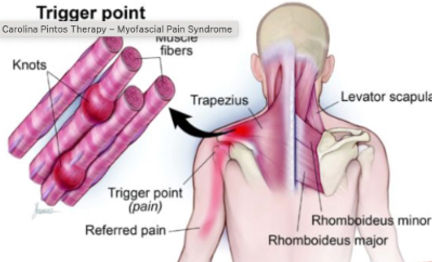
Myofascial pain syndrome belongs to the chronic pain disorders of the musculoskeletal system. Its hallmark is the trigger point (TP): a tiny focus of hyperexcitability tucked inside a contracted muscle cord. Prompted by pressure, by stretch or occasionally with no obvious cause, these spots set off a local ache that can spread to neighbouring areas.
Back in the 1950s, doctors Janet Travell and David Simons laid the groundwork for the concept: a hypersensitive spot buried in a hardened muscle that can refer a pain pattern typical of the muscle at fault. Their account splits the phenomenon in two:
- Active TP: sore whether you rest or exert yourself, it recreates the muscle's own referred pain.
- Latent TP: quiet until you press on it, it only wakes the pain once provoked.
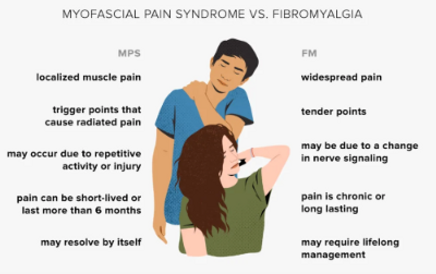
It is sometimes mistaken for other chronic pains, fibromyalgia first among them, yet two features set it apart: real trigger points you can feel under the fingers, and pain that stays more clearly confined.
Symptoms of myofascial pain syndrome
The most common features are:
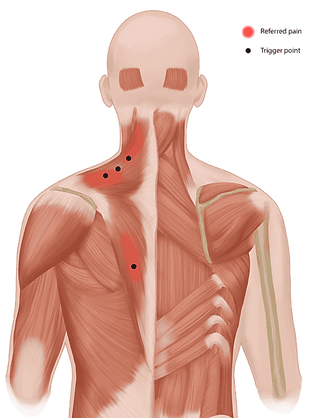
- a confined muscular ache, felt most often around the neck, the shoulders or the back
- active trigger points, those tender muscle spots that refer pain the moment they are pressed
- stiffness of purely muscular origin
- tiredness and disrupted sleep
- head pain
- imbalances in posture
Causes of myofascial syndrome and contributing factors
This syndrome almost never traces back to one isolated trigger. Research instead points to a cluster of mechanical, neurological and psychological factors that set the stage for trigger points and then push them into a lasting pattern.
Mechanical and postural causes
Repeated mechanical demand on the muscles sits at the top of the list. Drawing on a systematic review, a meta-analysis confirmed the link between a sedentary lifestyle and pain in both the neck and the lower back (Dzakpasu et al., 2021). Sitting for long stretches keeps several muscles locked in a shortened position, which readies the local contractures that typify the condition.
Repetitive gestures, athletic overload and a poorly set-up workstation operate the same way. Once demand outstrips a muscle's ability to recover, tight cords and tender nodules take shape. When researchers examined these sites, they measured raised local levels of inflammatory and pain-producing agents, among them substance P, bradykinin and several cytokines (Shah et al., 2008).
Neurological and emotional factors
Alongside the mechanical side, ongoing stress and psychological strain weigh in on their own. An umbrella review in The Clinical Journal of Pain pooled several systematic reviews and found that depression, anxiety and distress raise the odds that musculoskeletal pain both starts and sticks around (Martinez-Calderon et al., 2020).
Too little sleep likewise heightens how muscle pain is felt, something pain neuroscience has by now firmly documented (Finan, Goodin, & Smith, 2013). Because the relationship runs both ways, people living with chronic muscle pain tend to sleep poorly.
After a certain time, the pain can trigger central sensitisation: the nervous system begins to overstate the pain signal even when the original injury no longer warrants it (Woolf, 2011; Nijs et al., 2021). The issue stops being purely muscular at that stage, since the spinal cord and brain join the loop and the treatment plan has to adapt.
Old injuries and postural compensations
An old injury that never healed cleanly, whether a sprain, a fall or a road accident, sometimes leaves stubborn postural compensations. The international classification of chronic pain even carves out a dedicated heading, chronic post-traumatic pain, covering musculoskeletal pain that outlasts the normal healing window (Treede et al., 2019). By loading some muscle groups unevenly, these compensations breed trigger points far from where the injury first occurred and keep the syndrome going.
Diagnosis of myofascial pain syndrome
Clinical diagnosis
With no dedicated imaging test available, everything rests on a careful clinical work-up. It unfolds across several stages:
- In-depth interview: pattern, intensity, what aggravates or eases the pain
- Imaging: only when needed, to rule other diagnoses out
- Observation: spotting abnormalities and postural imbalances
- Palpation: hunting for the tight muscle cords and the trigger points
Telling myofascial pain syndrome and fibromyalgia apart
- Myofascial pain syndrome: a local or regional pain tied to trigger points, which clears once the condition is treated.
- Fibromyalgia: diffuse pain scattered across the whole body, long-lasting, and almost always paired with fatigue and disturbed sleep.
One and the same person may carry both pictures at once, which makes a rigorous diagnosis all the more necessary.
Treatment of myofascial pain syndrome
Specific injection techniques
Injecting a local anaesthetic or a corticosteroid into a trigger point rests the sore area for a while, brings down the inflammation on the spot and eases the pain in the short term. This procedure is usually paired with other approaches aimed at loosening the muscle.
Dry Needling
Dry Needling, also called "dry puncture", slips thin needles right into the heart of the trigger points. The technique helps settle the pain, unwind the tension and give the muscle back some function.
Osteopathy and manual therapy
Osteopathy holds a central place here thanks to precise hands-on work. The practitioner puts the hands to work toward several goals:
- Switch off the trigger points: ease the muscles where they have settled
- Get circulation moving: deliver better oxygen supply to the muscle tissue
- Rebuild postural balance: find and correct the asymmetries that feed the disorder
Stretching, mobilisation and self-rehabilitation
Stretching and mobilising the muscles helps undo the tension and win back suppleness. Alongside this, explaining the situation to the patient and handing over exercises to do alone supports day-to-day pain control and keeps recurrences at bay.
Advantages of osteopathy in the treatment of myofascial pain syndrome
- A direct hit on the trigger points: ischaemic compression inhibition frees the trigger points behind the referred pain. No other option is as gentle on the body.
- Regained joint mobility: with soft manoeuvres (fascial, muscle energy, adapted HVLA), the practitioner restores play to the neighbouring joints and lets the tension that feeds the trigger points fall away.
- A whole-person reading: this syndrome never shows up on its own. Posture, stress, poor sleep or repeated movements sustain it, and a qualified practitioner reviews each of these to fine-tune the response.
- Teaching and ergonomics: targeted stretches, a better desk posture, smarter load-sharing in sport. So many cues that leave the patient more self-reliant.

When should you consult an osteopath for chronic muscle pain?
The most widely used time marker comes from the international classification (Treede et al., 2019): pain counts as chronic once it lasts or keeps returning past three months. Once that line is crossed, the drivers are no longer only local, and central sensitisation, in which the nervous system inflates pain signals, can settle in (Woolf, 2011).
Several situations make it worth booking with an osteopath trained in chronic pain:
- muscle pain that has lingered for more than three months and shrugs off both rest and standard treatments
- tight, contracted areas that palpation finds every time, with or without referred pain hinting at trigger points
- knock-on effects on sleep, focus or everyday tasks
- a first-line treatment that failed or was poorly tolerated (painkillers, anti-inflammatories, physiotherapy on its own)
Conversely, a handful of red flags call for a doctor first. Measurable muscle weakness, tingling that will not fade, pain running along a defined nerve path, fever or unexplained weight loss can signal a deeper cause that needs medical assessment and, where appropriate, imaging. In that setting osteopathy supports the medical pathway and never stands in for it.
Holder of the French Diploma in Osteopathy (ESO Paris, six-year programme, awarded with high distinction) and a Master 2 in Movement Neurosciences (Paris Est-Créteil), Charbel Kortbawi has devoted more than 18 years of practice to chronic pain and sport. At the Active Health Clinic in Achrafieh, Beirut, the first consultation is there precisely to separate what osteopathy can handle from what belongs elsewhere. Once myofascial syndrome is confirmed, manual treatment focuses on the trigger points and the muscle chains at fault, with a concrete, checkable functional goal.
Appointments are arranged by phone or WhatsApp.
How many sessions are needed to treat myofascial syndrome?
No single protocol fits everyone. How many sessions are needed hinges on how long the pain has lasted, how many muscles are involved and the surrounding context, sleep, stress and activity level. Even so, the published evidence gives credible ballpark figures.
Acute form (1 to 3 sessions)
When the pain is recent (under six weeks) and follows a clear trigger such as a sudden movement or a one-time overload, 1 to 3 closely spaced sessions usually restore movement and quiet the main trigger points. Trials of manual therapy for musculoskeletal pain record clinically useful gains as early as the first few visits (Franke, Franke, & Fryer, 2014).
Chronic form (long-term follow-up, 4 to 8 spaced sessions)
Where chronic muscle pain has run past three months, care stretches out further. The OSTEOPATHIC randomised controlled trial, run with 455 patients who had chronic low back pain, relied on 6 osteopathic manual treatment sessions spread across 8 weeks, and the benefit for pain and function was still there at 12 weeks (Licciardone et al., 2013). Once that active phase ends, a review every 4 to 8 weeks can help lock in progress and head off relapse.
Factors influencing prognosis
Recovery speed rides on several variables. Signs of central sensitisation, sleep loss that keeps going, unaddressed chronic stress, plus psychological factors like depression and kinesiophobia (the fear of moving) all stretch the timeline out (Martinez-Calderon et al., 2020; Nijs et al., 2021). On the other side, sleeping well, easing back into movement step by step and dealing with stressors tilt the odds in the patient's favour. Pinning down a fixed session count before any assessment would therefore hold no credibility.
Prevention and daily habits
Preventing a relapse means reworking, over the long haul, the factors research has already flagged: a sedentary routine, drawn-out static postures, poorly handled stress and short sleep (Dzakpasu et al., 2021; Finan, Goodin, & Smith, 2013). Taken one at a time these levers look minor; put together, they carry real weight.
A few straightforward habits, built into the day, cut the risk of chronic muscle pain returning:
- break up still positions every 30 to 45 minutes with a short bout of movement
- aim for steady sleep of 7 to 9 hours and cut back on screens late in the evening
- keep up moderate, regular exercise scaled to how you feel that day
- spot and defuse chronic stress (breathing drills, psychological support if required)
- adjust your workstation to avoid postural strain that drags on
To dig deeper, several resources lay out the mechanisms and the practical steps: the blog articles on myofascial trigger points, chronic pain perception and neuromodulation of chronic pain round out this approach. None of these measures replaces individualised care, but each is a valuable support for it.
Scientific references
- Dzakpasu FQS, Carver A, Brakenridge CJ, Cicuttini F, Urquhart DM, Owen N, Dunstan DW. (2021). Musculoskeletal pain and sedentary behaviour in occupational and non-occupational settings: a systematic review with meta-analysis. International Journal of Behavioral Nutrition and Physical Activity, 18(1), 159.
- Finan PH, Goodin BR, Smith MT. (2013). The association of sleep and pain: an update and a path forward. The Journal of Pain, 14(12), 1539-1552.
- Franke H, Franke JD, Fryer G. (2014). Osteopathic manipulative treatment for nonspecific low back pain: a systematic review and meta-analysis. BMC Musculoskeletal Disorders, 15, 286.
- Licciardone JC, Minotti DE, Gatchel RJ, Kearns CM, Singh KP. (2013). Osteopathic manual treatment and ultrasound therapy for chronic low back pain: a randomized controlled trial. Annals of Family Medicine, 11(2), 122-129.
- Martinez-Calderon J, Flores-Cortes M, Morales-Asencio JM, Luque-Suarez A. (2020). Which Psychological Factors Are Involved in the Onset and/or Persistence of Musculoskeletal Pain? An Umbrella Review of Systematic Reviews and Meta-Analyses of Prospective Cohort Studies. The Clinical Journal of Pain, 36(8), 626-637.
- Nijs J, George SZ, Clauw DJ, Fernández-de-las-Peñas C, Kosek E, Ickmans K, et al. (2021). Central sensitisation in chronic pain conditions: latest discoveries and their potential for precision medicine. The Lancet Rheumatology, 3(5), e383-e392.
- Shah JP, Danoff JV, Desai MJ, Parikh S, Nakamura LY, Phillips TM, Gerber LH. (2008). Biochemicals associated with pain and inflammation are elevated in sites near to and remote from active myofascial trigger points. Archives of Physical Medicine and Rehabilitation, 89(1), 16-23.
- Treede RD, Rief W, Barke A, Aziz Q, Bennett MI, Benoliel R, et al. (2019). Chronic pain as a symptom or a disease: the IASP Classification of Chronic Pain for the International Classification of Diseases (ICD-11). Pain, 160(1), 19-27.
- Woolf CJ. (2011). Central sensitization: implications for the diagnosis and treatment of pain. Pain, 152(3 Suppl), S2-S15.
Frequently Asked Questions
FAQ
What exactly is a trigger point, and how does an osteopath ease it?
A trigger point is a hyper-irritable focus inside a muscle that gives rise to pain both locally and at a distance. To settle it down, the osteopath blends ischaemic compression, fascial stretching and post-isometric relaxation to quiet these sensitive spots.
How do fibromyalgia and myofascial pain syndrome differ?
Fibromyalgia reaches across the whole body, with diffuse pain, lasting fatigue and broken sleep. Myofascial pain syndrome instead stays within certain muscles that carry identifiable trigger points. The two can overlap, yet each calls for its own line of care.
How many sessions to treat myofascial pain syndrome?
With a recent or acute presentation, 3 to 5 sessions are usually enough. With a chronic one loaded with active trigger points, expect 6 to 10 sessions, backed by a daily home stretching programme to hold on to the gains.
Which muscles are most often affected by myofascial pain syndrome?
The usual suspects are: the trapezius and the levator scapulae (neck pain and head pain), the quadratus lumborum (low back pain), the piriformis and gluteal muscles (sciatica), the sternocleidomastoid (dizziness, facial pain) and the chewing muscles (jaw pain).
Can myofascial syndrome be completely cured?
In most instances, care that starts before the three-month mark defined by the international classification makes a full recovery achievable (Treede et al., 2019). After that window, the course depends on which mechanisms are at play. Once central sensitisation has taken hold, the aim shifts toward a durable drop in symptoms rather than their instant removal, blending manual therapy, a phased return to movement, sound sleep and stress control. The clinical target then becomes a return to sound, measurable function, not a pledge of total cure.
Does stress really worsen trigger points?
Yes, and it is more than a feeling. An umbrella review drawing on systematic reviews found that chronic stress, depression and anxiety push up both the chance that musculoskeletal pain appears and the chance that it lingers, apart from any mechanical cause (Martinez-Calderon et al., 2020). Stress keeps a baseline of muscle tension going and erodes sleep, two settings that encourage trigger points to form and flare again. Managing chronic muscle pain therefore gains from taking these elements into account.
Why does my myofascial syndrome keep returning to the same spot?
When pain keeps returning to the same muscle, it means the triggers are still there: the same work posture, the same repeated movement, too little sleep or lasting stress (Dzakpasu et al., 2021). At the local level, biochemical study of active trigger points shows an inflammatory, acidic environment that endures and keeps the muscle sensitive (Shah et al., 2008). As long as that mix of mechanical and system-wide causes stays put, the fragile muscle finds again the conditions of the first flare-up. That is why prevention counts every bit as much as treatment.