Sports
Sports osteopathy focuses on the musculoskeletal disorders associated with physical activity. Repeated mechanical stress, muscle imbalances or an unsuitable training load can favour the onset of pain or injuries. Charbel Kortbawi, osteopath in Beirut, supports amateur and competitive athletes at the Active Health Clinic in their prevention and recovery.
The consultation is generally based on:
- An analysis of sporting and medical history
- A postural and biomechanical assessment
- A functional movement examination
- A manual treatment tailored to the sport practised
- Personalised advice on training, recovery and injury prevention
This approach aims to improve joint mobility, reduce certain muscle tensions and promote optimal body adaptation to the demands of exercise.
Sports osteopathy: what role for athletes?
Sporting activity places significant biomechanical stress on the body that can lead to musculoskeletal pain, functional limitations or injuries.
Charbel J. Kortbawi, sports osteopath in Beirut – Achrafieh, supports amateur and professional athletes in the management of injuries and pain related to sports. A qualified osteopath holding a Master 2 in Neurosciences of Movement, he offers an approach based on biomechanical analysis, current scientific evidence and clinical recommendations.
The goal of care is to reduce pain, restore mobility and encourage a gradual return to physical activity under the best possible conditions, alongside other treatments in place.
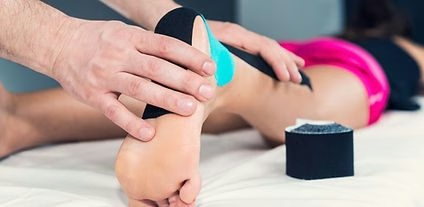
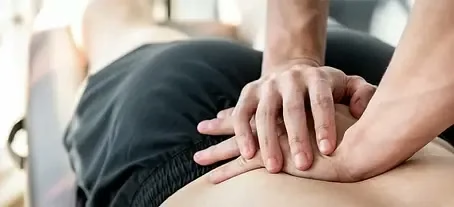
Reasons to consult a sports osteopath in Beirut
Athletes frequently consult a sports osteopath for musculoskeletal pain or disorders related to their sporting practice. Repeated mechanical stress, an unsuitable training load, certain mobility limitations or biomechanical imbalances can favour the onset of pain or injuries.
At the Achrafieh osteopathy practice in Beirut, consultations typically address:
- Tendinopathies (Achilles tendon, knee, shoulder, elbow)
- Sprains, particularly of the ankle or knee
- Iliotibial band syndrome (runner's knee) in runners
- Athletic pubalgia
- Shin splints (tibial periostitis)
- Plantar fasciitis
- Low back pain related to sports
- Neck pain associated with certain sporting disciplines
- Postural imbalances
These disorders are often multifactorial and can be linked to training load, sporting technique, recovery or certain biomechanical imbalances.
What sports injuries are treated with osteopathy?
Each of the injuries mentioned above is managed with a specific approach, adapted to the biomechanics of the discipline and the stage of the lesion. The pages below gather the clinical reference points useful to athletes: mechanisms of onset, diagnostic criteria, conservative management and reasonable timeframes for returning to sport.
Athletic pubalgia
Chronic groin pain in athletes. Learn more
Tendinopathies
Achilles, shoulder, elbow, knee. Learn more
Shin splints
Shin pain in runners. Learn more
Plantar fasciitis
Heel and arch pain. Learn more
Iliotibial band syndrome
Runner's knee. Learn more
Knee pain in athletes
Diagnosis and management. Learn more
Tennis elbow
Lateral epicondylitis. Learn more
Piriformis syndrome
Sciatic-type pain in athletes. Learn more
Injury prevention and sports recovery
In athletes, osteopathy can also form part of a preventive approach. The goal is to identify certain mobility restrictions or biomechanical adaptations that may increase the risk of injury.
Optimal joint mobility and good movement control contribute to more effective sports practice and better tolerance of training demands.
After intense effort or competition, osteopathic care can also help improve functional recovery and reduce certain muscle tensions.
Which osteopathic approach for each sporting discipline?
Musculoskeletal stresses vary considerably from one discipline to another. A distance runner does not have the same vulnerabilities as a tennis player, nor does a cyclist have the same needs as a strength athlete. With more than 18 years of clinical experience in Lebanon and internationally, Charbel Kortbawi systematically includes the dominant sporting movement, the weekly training volume and the patient's competition calendar in the assessment.
Running and trail running
Running concentrates the most frequent reasons for consultation at the clinic: shin splints, iliotibial band syndrome, plantar fasciitis, Achilles and patellar tendinopathies. Care is never limited to the painful segment: it includes analysis of the running gait, footwear, distribution of training load and recovery habits. Runners preparing for a road race (10 km, half marathon, marathon) benefit from structured support built around their preparation cycle.
Team sports and racquet sports
Football, rugby, basketball, tennis, padel: these disciplines combine explosive efforts, changes of direction and asymmetric loading. Athletic pubalgia, patellar tendinopathy, lateral epicondylitis and rotator cuff tendinopathies are commonly seen. The assessment takes the sporting technique into account when it is involved, and is coordinated with the competition calendar.
Cycling, swimming and strength sports
These low-impact disciplines generate their own constraints: prolonged posture on the bike, the repetitive movement of front crawl, axial loading in strength sports. Neck and upper back pain, rotator cuff problems and low back pain are among the recurring reasons for consultation. A postural adjustment (position on the bike, swimming technique, lifting technique) often accompanies the manual treatment.
An approach grounded in biomechanics and neuroscience
Charbel J. Kortbawi has been an osteopath D.O. since 2008 and holds a Master 2 in Neurosciences of Movement, along with several university diplomas in the field of pain and clinical anatomy.
His approach is based on the analysis of interactions between:
- The musculoskeletal system
- Neuromuscular control of movement
- Biomechanical stresses related to sports practice
Each consultation includes an individualised clinical assessment in order to adapt care to the specific needs of the athlete and the demands of their discipline.
The osteopathy practice is located at the Active Health Clinic in Achrafieh, Beirut, and welcomes athletes from across Beirut and Lebanon.
How to manage training load to avoid injury?
The onset of an overuse injury is almost never linked to a single factor. The work of Gabbett (British Journal of Sports Medicine, 2016) established that the ratio between acute and chronic load, known as the acute:chronic workload ratio, is one of the most predictive parameters of injury risk in athletes. In practical terms: a sudden increase in volume or intensity over one week, without gradual progression over the previous three to four weeks, significantly multiplies the risk of tendinopathy, shin splints or muscle injury.
Sports osteopathy does not directly intervene in training planning, which is the responsibility of the coach or the athlete. However, holding a university diploma in Sport and Health (D.U. Sport et Santé, Université Paris Cité), Charbel Kortbawi includes the analysis of recent load and progression periods in every clinical consultation: identifying a progression that was too fast makes it possible to adjust the return-to-training strategy and avoid repeating the same injury pattern.
This reading of training load also applies to the return after injury. A return to the previous volume can only take place after progressive consolidation of tissue capacity, a step often neglected in rushed comebacks before competition.
Returning to sport after an injury: what criteria?
Returning to sport after an injury is not simply a matter of pain disappearing at rest. The international return-to-sport consensus (Ardern et al., British Journal of Sports Medicine, 2016) defines several domains to assess before authorising the return: functional capacity of the injured limb, symmetry of strength and mobility compared with the opposite side, tolerance of a progressive discipline-specific effort, and the absence of limiting psycho-behavioural factors (kinesiophobia, apprehension).
In practice, a runner who has had an Achilles tendinopathy does not immediately return to their usual volume. Reloading is done in stages, within pain tolerance: a numerical scale from 0 to 10 is used, with a common threshold set at 3-4/10 during exercise and in the following 24 hours. Well-managed tendinopathies respond to progressive load management over 6 to 12 weeks, combined with eccentric strengthening work.
A premature return to the previous volume is one of the main causes of recurrence. This is particularly true for athletic pubalgia, shin splints and iliotibial band syndrome: three reasons for consultation where a rushed return is frequently found in the patient's history.
Frequently Asked Questions (FAQ)
When should I consult a sports osteopath?
You can consult in case of pain related to physical activity, after an injury, or as part of a prevention approach to assess mobility limitations that may favour the onset of musculoskeletal disorders.
How long does a consultation last?
A consultation generally lasts around 45 minutes and includes a clinical interview, a movement assessment and an appropriate treatment.
Sports osteopath or physiotherapist?
The two approaches are complementary. Osteopathy mainly acts on mobility and biomechanical dysfunctions, while physiotherapy is often involved in rehabilitation and muscle strengthening.
Are consultations suitable for amateur athletes?
Yes. Sports osteopathy is suitable for amateur athletes as well as regular or competitive athletes.
How many sessions are needed after a tendinopathy?
The number of sessions depends on the anatomical site, how long the symptoms have been present and the recent training load. For a recent tendinopathy (less than 6 weeks) in a regular athlete, 3 to 5 sessions spread over 6 to 8 weeks are generally sufficient. A chronic tendinopathy (more than 3 months) requires a longer follow-up, often 6 to 10 sessions over 3 to 4 months, combined with an eccentric strengthening programme. Complete resolution of symptoms sometimes occurs several weeks after the last session.
When should I see an osteopath before a competition?
A preparation consultation is ideally planned 10 to 14 days before a major competition: early enough for the body to adapt to the changes made, close enough to benefit from the work carried out. A session within 48 hours of a race is not recommended: manual treatment can temporarily alter proprioceptive sensitivity and disturb the automatic patterns of the sporting movement.
Can I keep running with shin splints?
It depends on the stage. In the initial phase, when pain only occurs during exercise and disappears at rest, reducing volume by 30 to 50% and working on contributing factors (footwear, terrain, running technique) often make it possible to keep running. If pain persists at rest or when walking, a temporary break (2 to 4 weeks) combined with substitute activities (cycling, swimming) is necessary. Neglected shin splints can progress to a stress fracture.
After a trauma (fall, sprain), how soon can I consult?
An acute trauma (ankle sprain, fall, impact) first requires a medical assessment to rule out a fracture or a lesion requiring imaging. Once this step has been completed, osteopathy can intervene from the subacute phase (48 to 72 hours after the trauma), focusing first on adjacent uninjured regions to limit early postural compensations. The injured area itself is addressed later, once the inflammatory phase has resolved.