Temporomandibular disorders
Care provided by Charbel Kortbawi, osteopath in Beirut, at Active Health Clinic in Achrafieh.
Understanding chronic jaw pain
Definition and epidemiology
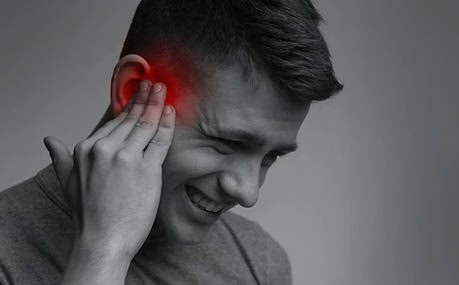
Among the musculoskeletal pains that settle in over time, those of the temporomandibular joint (TMJ) rank second, just behind the lower back, and affect between 6 and 9% of adults worldwide. The picture combines discomfort in the jaw and neighbouring tissues with other complaints: headaches, ear pain, joint noises or crepitus, and chewing that feels less smooth. Pain is called chronic once it lasts beyond three months.
What are the causes?
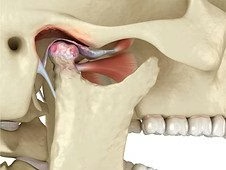
- A problem within the joint itself: disc displacement, TMJ osteoarthritis
- A myofascial origin tied to bruxism and clenching, where muscle overload produces tender trigger points
- Single impacts or repeated microtrauma: a lengthy dental procedure, a blow to the face or the neck
- General inflammatory diseases such as rheumatoid arthritis or spondyloarthritis, which can reach the joint
When they persist, these aggressions encourage central sensitisation: the pain threshold drops and the nervous system overreacts to every signal. On top of this biological groundwork, psychological and environmental factors come into play, from stress and anxiety to low mood, work overload, poor-quality sleep or a lack of social support.
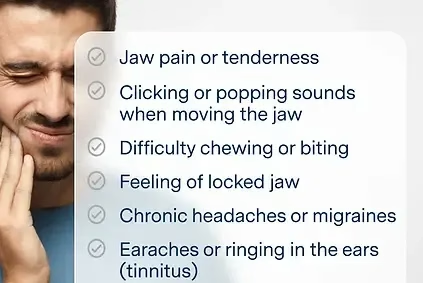
Symptoms of jaw pain
- Pain right in front of the ear
- Pain in the jaw itself
- Painful tension in the chewing muscles
- Headaches
- Joint sounds: clicking, grating
- A reduced range of mouth opening
- Tinnitus
SADAM, TMJ, DC/TMD: making sense of the terms
The literature uses several labels for one and the same reality. The traditional French acronym is SADAM (Syndrome Algo-Dysfonctionnel de l'Appareil Manducateur), while international publications favour TMD (Temporomandibular Disorders). Take care not to mix them up: the letters TMJ name only the joint, never the disorder itself.
The current diagnostic reference is the DC/TMD (Diagnostic Criteria for Temporomandibular Disorders). Released in 2014 under an international consortium led by Schiffman and Ohrbach, it sorts the disorders into three families:
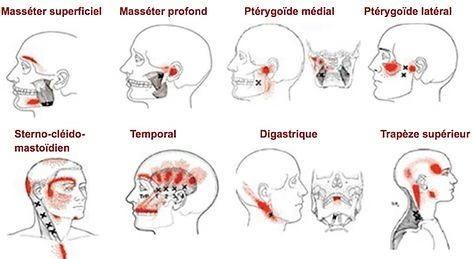
- Muscular origin: myofascial pain of the masseter, temporalis and pterygoid muscles, brought on by palpation or by the effort of contraction. This is the reason seen most often in osteopathic practice.
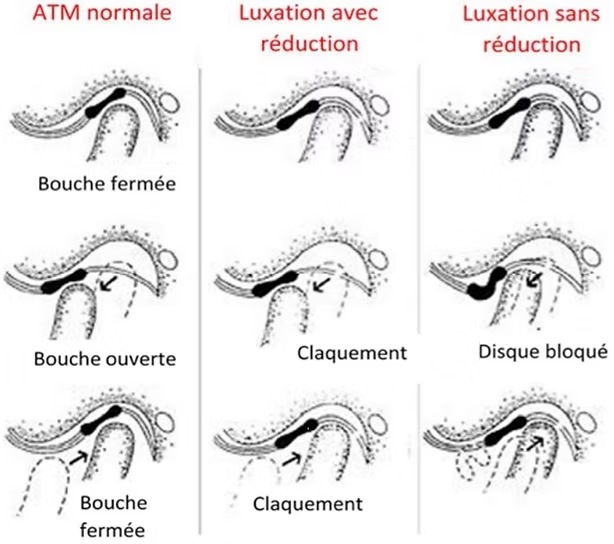
- Intra-articular origin: disc displacements with or without reduction, arthralgia, TMJ osteoarthritis, frequently betrayed by a click, a catch or a passing lock.
- Mixed forms: both mechanisms present together in the same person.
To this clinical axis the DC/TMD adds a second strand devoted to psychological impact (anxiety, depression, a tendency to catastrophise), in keeping with the biopsychosocial reading championed by the BMJ 2023 guideline.
Which signs should draw attention?
Several observations point towards a TMJ disorder and help fine-tune the care plan:
- Preauricular pain: felt just in front of the tragus, it grows worse when chewing or on forced opening.
- Reduced mouth opening: the DC/TMD sets 40 mm between the incisors as the international reference threshold; below that, opening is regarded as restricted.
- Joint noises: clicking suggests a reducible disc displacement, whereas crepitus points more to an osteoarthritic component.
- Locking on opening or closing: brief or lasting episodes, not to be confused with plain morning stiffness.
- Referred pain: earache with no ENT cause, temporal headache, upper neck pain, a sense of a blocked ear.
Some situations call for a medical opinion before any manipulation: a complete, sudden lock on opening, difficulty swallowing, unexplained weight loss, fever, or a history of head and neck cancer. These fall outside the remit of osteopathy and belong with a physician.
A close link between jaw, neck and headaches
People with a TMD frequently describe upper neck pain and headaches alongside the jaw itself. This overlap is no accident: it stems from a well-mapped neuroanatomical convergence.
The sensory information carried by the trigeminal nerve, which serves the jaw, the face and part of the skull, meets that of the upper cervical roots C1, C2 and C3 at a shared relay in the brainstem, the trigeminocervical nucleus. Described by Bogduk in 1992, this convergence forms the neurophysiological basis of cervicogenic headache.
In clinical terms, work by Fernández-de-las-Peñas and colleagues, published in 2010, revealed in women with myofascial TMD active trigger points in both the chewing muscles (temporalis, masseter) and the upper neck muscles (upper trapezius, sternocleidomastoid, suboccipitals). The referred-pain territories of these points overlap exactly with the areas where patients locate their headaches.
The takeaway: focusing only on the jaw in someone who also carries neck tension means treating just a fragment of the problem. Osteopathy assesses and releases the whole cervical-cephalic chain, which is why an improvement in the jaw is often matched by a drop in headaches and in the sensation of a blocked ear.
How chronic jaw pain is treated
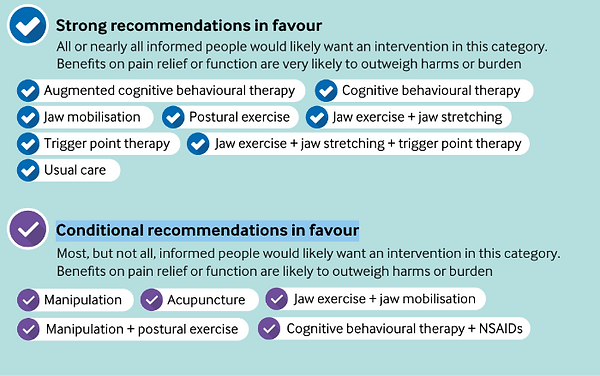
What the BMJ (British Medical Journal) advised in December 2023
Strongly recommended in favour:
- Cognitive behavioural therapy (CBT)
- Passive joint mobilisations
- Posture-focused exercises
- Stretches and exercises for the TMJ muscles
- Trigger point therapy
- Standard care
Recommended in favour, with conditions:
- Manipulation
- Non-steroidal anti-inflammatory drugs + CBT
- Acupuncture
- Joint mobilisations combined with exercises
Treatment with osteopathy and manual therapy in Beirut
This care is part of our broader work on chronic musculoskeletal pain.
Scientifically proven efficacy of osteopathic treatment
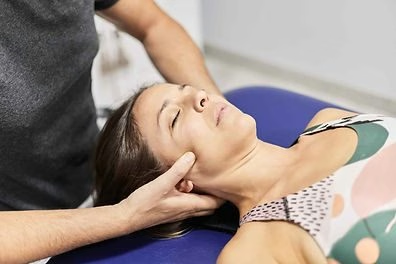
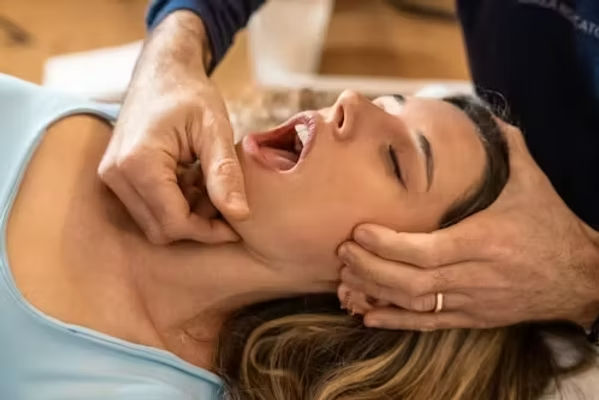
The scientific evidence confirms the value of osteopathy and manual therapy for chronic jaw pain: studies report a clear fall in pain and a gain in patients' quality of life. The hands-on work, precise and safe, aims to ease both the muscles around the temporomandibular joint and those of the cervical region.
Charbel Jean Kortbawi (D.O., M.Sc.) sees patients dealing with acute and chronic TMJ pain at his practice in Achrafieh, Beirut. Holder of the French Diploma in Osteopathy (ESO Paris, Bac+6, with highest honours) and of a Master 2 in Movement Neuroscience (Paris Est-Créteil), he has rounded out his training with several university diplomas dedicated to pain, including Chronic Pain Management (Sorbonne) and Pain and Human Movement (UPHF). A member of the SFETD (through the C2R) and of the IASP, with more than 18 years of experience and a background at the American Hospital of Paris, he places jaw care within a broader approach to pain.
Osteopath, dentist, orthodontist: each with a role
The BMJ 2023 guideline for TMD argues for coordinated, multimodal care, with each professional acting on one facet of the problem:
- The dentist examines the occlusion, looks for any infectious foci, makes an occlusal splint where needed (indicated in confirmed bruxism), and treats caries or periodontal disease that can keep the pain going.
- The orthodontist steps in when the dysfunction stems from marked malocclusion (significant class II, anterior open bite, transverse discrepancy), usually after an initial dental assessment.
- The osteopath handles the muscular side (masseter, temporalis, pterygoids), the functional mobility of the TMJ and the associated cervical chain, while weaving in pain education and postural advice.
- The psychologist (CBT) comes in when stress, anxiety or catastrophising feed the bruxism and the pain; this is a strong BMJ 2023 recommendation.
Far from competing, these approaches gain in effectiveness when they are combined. Care aimed at a single dimension often leaves aside whatever sustains the pain over the long run. The question of support for a myofascial syndrome often arises in chronic presentations, where trigger points in the chewing muscles play a central part.
Frequently Asked Questions (FAQ)
How many sessions does jaw pain usually take?
For a chronic TMJ problem, plan on roughly 4 to 6 sessions; acute pain can ease from as few as 2 to 3 sessions. Working hand in hand with the dentist, notably through an occlusal splint, clearly improves the results.
Dentist or osteopath: who should I see first for the jaw?
The two forms of care complement each other. The dentist deals with the occlusal side (splint, dental adjustment) while the osteopath handles the muscular and articular components. Coordinating the two is advised, in line with the BMJ 2023 recommendations.
Does osteopathy have an effect on night-time bruxism?
By easing the muscles worked by bruxism (masseter, temporalis, pterygoids), osteopathy can space out the episodes. It does not address the psychological side of bruxism, which is the remit of CBT.
Which symptoms suggest a TMJ disorder?
The usual picture includes pain just ahead of the ear, trouble opening the mouth fully, clicking or grating from the joint, headaches, neck pain on the same side and, sometimes, tinnitus. One side alone may be involved, or both at once.
A jaw that clicks, should I worry?
An isolated click, with no pain and no restricted opening, is commonplace in adults and needs no treatment on its own. It matters more when paired with pain, locking, a deviation on opening, or trouble chewing; an assessment then helps establish whether it reflects a reducible disc displacement.
How long does it take to free a locked jaw?
An acute closed lock, where opening is impossible beyond about 25 to 30 mm, is a relative emergency to assess within 48 to 72 hours. When care starts early, range usually returns within 1 to 3 sessions; a lock present for several weeks calls for longer follow-up, often paired with a dental review.
Is osteopathy effective without a dental splint?
Yes: on the muscular and articular components of TMD, osteopathy can be enough on its own. A splint adds something when night-time bruxism is confirmed. The BMJ 2023 guide strongly recommends manual therapy, exercises, CBT and pain education, with the occlusal splint advised only under certain conditions depending on the clinical picture.
Can osteopathy ease tinnitus that comes from the jaw?
Some tinnitus shifts with the position and contraction of the jaw, a sign of a somatosensory origin tied to trigeminocervical convergence. In these patients, combining work on the jaw and the upper cervical spine can soften the intensity or the frequency of the tinnitus. Osteopathy, by contrast, has no effect on tinnitus of cochlear origin. More detail in the dedicated article.
Scientific references
- Schiffman E, Ohrbach R, Truelove E, et al. Diagnostic Criteria for Temporomandibular Disorders (DC/TMD) for Clinical and Research Applications. J Oral Facial Pain Headache. 2014;28(1):6-27. doi.org/10.11607/jop.1151
- Busse JW, Casassus R, Carrasco-Labra A, et al. Management of chronic pain associated with temporomandibular disorders: a clinical practice guideline. BMJ. 2023;383:e076227. doi.org/10.1136/bmj-2023-076227
- Armijo-Olivo S, Pitance L, Singh V, Neto F, Thie N, Michelotti A. Effectiveness of Manual Therapy and Therapeutic Exercise for Temporomandibular Disorders: Systematic Review and Meta-Analysis. Phys Ther. 2016;96(1):9-25. doi.org/10.2522/ptj.20140548
- Slade GD, Ohrbach R, Greenspan JD, et al. Painful Temporomandibular Disorder: Decade of Discovery from OPPERA Studies. J Dent Res. 2016;95(10):1084-1092. doi.org/10.1177/0022034516653743
- Lobbezoo F, Ahlberg J, Raphael KG, et al. International consensus on the assessment of bruxism: Report of a work in progress. J Oral Rehabil. 2018;45(11):837-844. doi.org/10.1111/joor.12663
- List T, Jensen RH. Temporomandibular disorders: Old ideas and new concepts. Cephalalgia. 2017;37(7):692-704. doi.org/10.1177/0333102416686302
- Fernández-de-las-Peñas C, Galán-del-Río F, Alonso-Blanco C, Jiménez-García R, Arendt-Nielsen L, Svensson P. Referred pain from muscle trigger points in the masticatory and neck-shoulder musculature in women with temporomandibular disorders. J Pain. 2010;11(12):1295-1304. doi.org/10.1016/j.jpain.2010.03.005
- Bogduk N. The anatomical basis for cervicogenic headache. J Manipulative Physiol Ther. 1992;15(1):67-70. PMID 1740655